
ACHILLES TENDON RUPTURE REHAB & RETURN-TO-SPORT PROGRAM
A performance-first plan built around progressive loading, calf strength symmetry, and clear return-to-sport criteria.
Recovering from an Achilles tendon rupture isn’t just about healing the tendon.
It’s about restoring strength, rebuilding elastic power, and preparing your lower leg to handle sprinting, cutting, jumping, and high-speed deceleration again.
Many athletes feel “okay” walking long before their tendon is ready for sport. Without progressive loading and objective strength testing, re-injury risk stays higher and performance remains limited.
At The Lab, our Achilles rupture rehab program is designed for athletes and active individuals who want more than basic physiotherapy. We follow a phased, performance-driven model with clear progress markers so you always know where you’re at and what comes next.
WHO THIS PROGRAM IS FOR
This program is built for:
- Field sport athletes (soccer, football, rugby, lacrosse)
- Court sport athletes (basketball, volleyball)
- Runners and sprinters
- Recreational lifters and gym athletes
- Active adults returning to training
- Athletes preparing for cutting and acceleration demands
Whether you’re early post-op or months into rehab and feeling stuck, we’ll meet you where you are and build forward from there.
WHY ACHILLES REHAB NEEDS A PERFORMANCE-FOCUSED APPROACH
Achilles rehab is often treated as a timeline, but return to sport is not about time. It’s about capacity.
Your Achilles tendon has a demanding job. It needs to handle powerful calf contractions, store and release elastic energy when you sprint, manage rapid deceleration, and tolerate repeated loading even when your body is fatigued. That’s a lot to ask of one structure, especially after injury.
When calf strength, tendon stiffness, and single-leg power aren’t fully restored, athletes often feel it. Push-off strength can feel weaker. Acceleration may not come as easily. The calf can continue to feel underpowered or unreliable. There’s often a lingering fear of re-rupture, and the body may start to compensate in subtle ways that shift stress into other areas.
Our approach is designed to address all of this directly. We use progressive calf loading to rebuild capacity, prioritize unilateral strength to restore side-to-side balance, and train end-range dorsiflexion control to improve resilience through full movement. From there, we layer in elastic and plyometric training to prepare the tendon for higher-speed demands. Throughout the process, we use objective strength and power testing to ensure athletes are not just feeling better, but truly ready to return with confidence.
The goal is simple: return to sport strong, powerful, and confident.
WHAT TO EXPECT AT YOUR POST-OP ACHILLES ASSESSMENT
Your initial assessment at The Lab includes:
1. Injury + Surgery Review
We’ll review your rupture type, surgical approach (if applicable), immobilization timeline, and current activity level.
2. Symptom + Swelling Screen
We assess pain, swelling, stiffness, and daily load tolerance to determine appropriate progression.
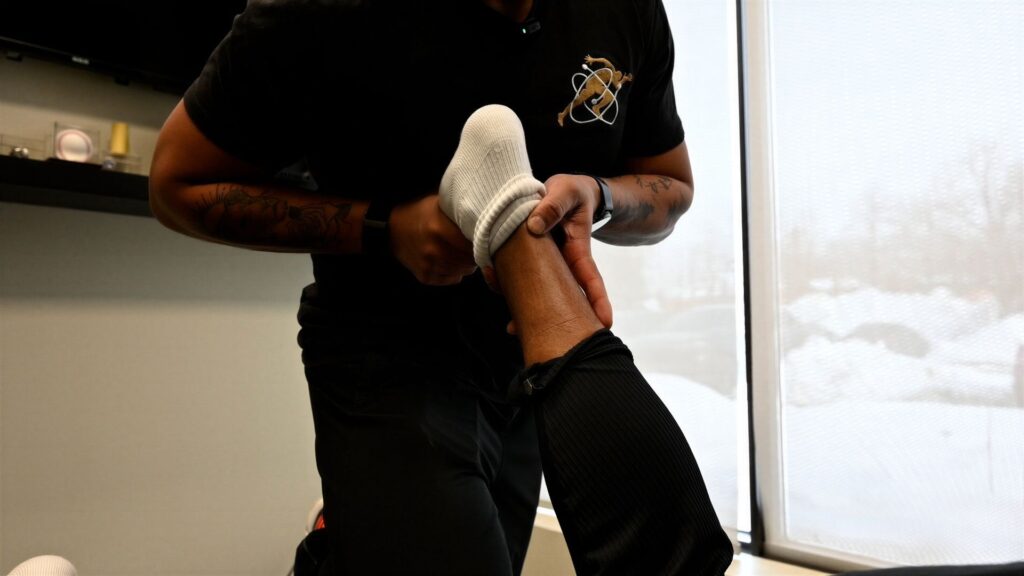
3. Movement + Strength Assessment
Depending on your stage, we assess:
- Ankle range of motion
- Calf activation and strength
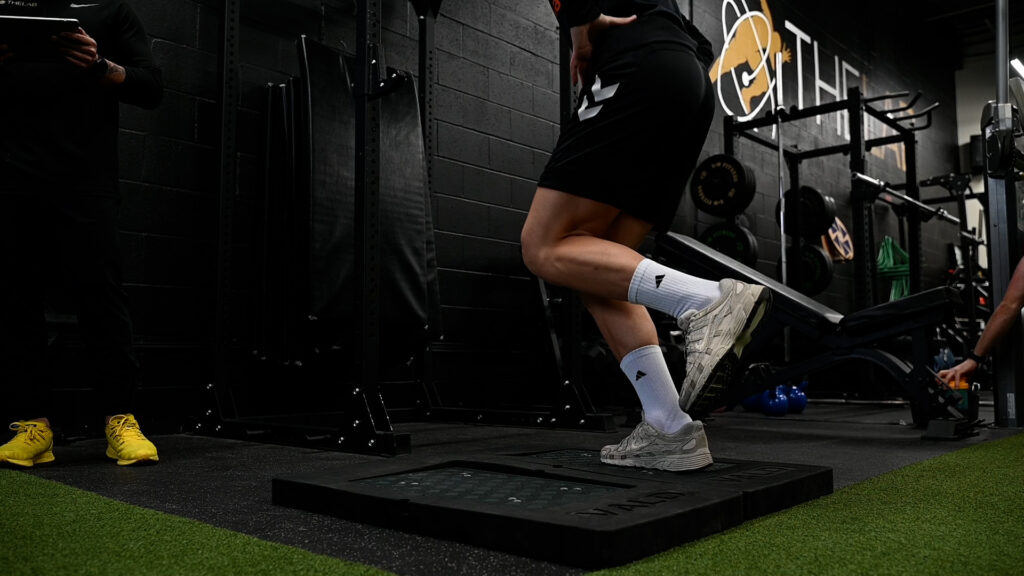
- Single-leg heel raise capacity
- Dorsiflexion control
- Gait and push-off mechanics
- Force tolerance in standing and walking
4. Clear Phase-Based Plan
You’ll leave with:
- A rehab plan tailored to your current phase
- Clear calf strength and performance targets
- A structured home and gym program
- Recommendations for frequency and progression
ACHILLES RUPTURE REHAB
What the process looks like
Every rupture is different. Every athlete progresses differently.
But strong Achilles return-to-sport rehab follows a clear progression:
Phase 1: Early Recovery
In this initial stage, the priority is protecting the healing tendon while gradually restoring movement and muscle activity. We introduce controlled weight-bearing progressions, gentle ankle mobility work, and early calf activation to re-establish neuromuscular connection. Swelling and symptom management are carefully monitored so the tendon can adapt without being overstressed.
Phase 2: Strength Rebuild
Once the tendon is ready, the focus shifts to rebuilding force capacity. Progressive calf loading begins with seated and standing variations, then transitions toward single-leg strength development. Loads are advanced methodically within gym-based movements to improve tolerance and restore confidence in the injured side.
Phase 3: End-Range Control
At this stage, we strengthen the ankle through deeper dorsiflexion ranges and improve control under load. Emphasis is placed on controlled lowering mechanics, single-leg stability, and deceleration capacity. This prepares the tendon and surrounding structures for more dynamic and unpredictable movement demands.
Phase 4: Dynamic & Power Development
Here, we reintroduce speed and elasticity. Jumping and landing progressions, acceleration drills, and gradually intensified plyometrics help rebuild rate of force development. Elastic rebound training restores the spring-like qualities essential for sprinting and explosive performance.
Phase 5: Return-to-Sport Preparation
The final phase bridges rehabilitation and competition. Athletes progress through structured sprint work, cutting and change-of-direction drills, and fatigue-based conditioning. Objective strength and hop testing benchmarks guide decision-making, ensuring readiness is based on measurable performance rather than assumption.
RETURN-TO-SPORT TESTING (AND WHY IT MATTERS)
One of the biggest gaps in Achilles rehab is objective strength testing.
At The Lab, we use performance benchmarks to help answer key questions:
- Is my surgical calf strong enough compared to the other side?
- Can my tendon tolerate sprint-level force?
- Am I ready for cutting and rapid deceleration?
- Is my power output symmetrical?
Testing gives you clarity. It also gives your surgeon or sports medicine team better information for clearance decisions.
COMMON QUESTIONS AFTER AN ACHILLES RUPTURE
How long does Achilles recovery take?
Full return to high-level sport often takes 9–12 months or longer. True readiness depends on calf strength, tendon capacity, and sport demands.
When can I start running again?
Running is introduced when strength, swelling, and movement control meet specific criteria, not simply based on time.
Why does my calf still feel weak months later?
Calf strength deficits are common after rupture. Without structured loading progression, strength may not fully return.
Will my tendon ever feel normal again?
With progressive loading and proper rehab, most athletes regain strong function. Stiffness or tightness early on is common and manageable.
What if I’m afraid to push off hard?
Fear of re-rupture is common. We use progressive exposure and measurable milestones to rebuild confidence safely.
How often do I need to come in?
Frequency depends on your phase and goals. Some athletes benefit from weekly coaching, others use structured check-ins.

WHAT MAKES THE LAB DIFFERENT
Achilles rehab should prepare you for sprinting, jumping, and competition, not just walking pain-free.
At The Lab, our post-operative Achilles rehab is built for athletes who want:
- Clear phase-based progressions
- Objective calf strength benchmarks
- Structured return-to-running protocols
- Integrated strength and performance training
- Coaching that builds confidence through measurable progress
We’re not here to rush you. We’re here to return you to sport ready.


Ready to Start Achilles Rehab With a Clear Plan?
If you’ve experienced an Achilles tendon rupture and want a rehab plan built around progressive loading, performance benchmarks, and return-to-sport readiness, book your post-op assessment today.